Quiet-Time Activities for Toddlers Who Won’t Nap
When a nap disappears, the answer is not a giant activity closet. Start with one question: does your preschooler settle more easily when they color, build, or listen?
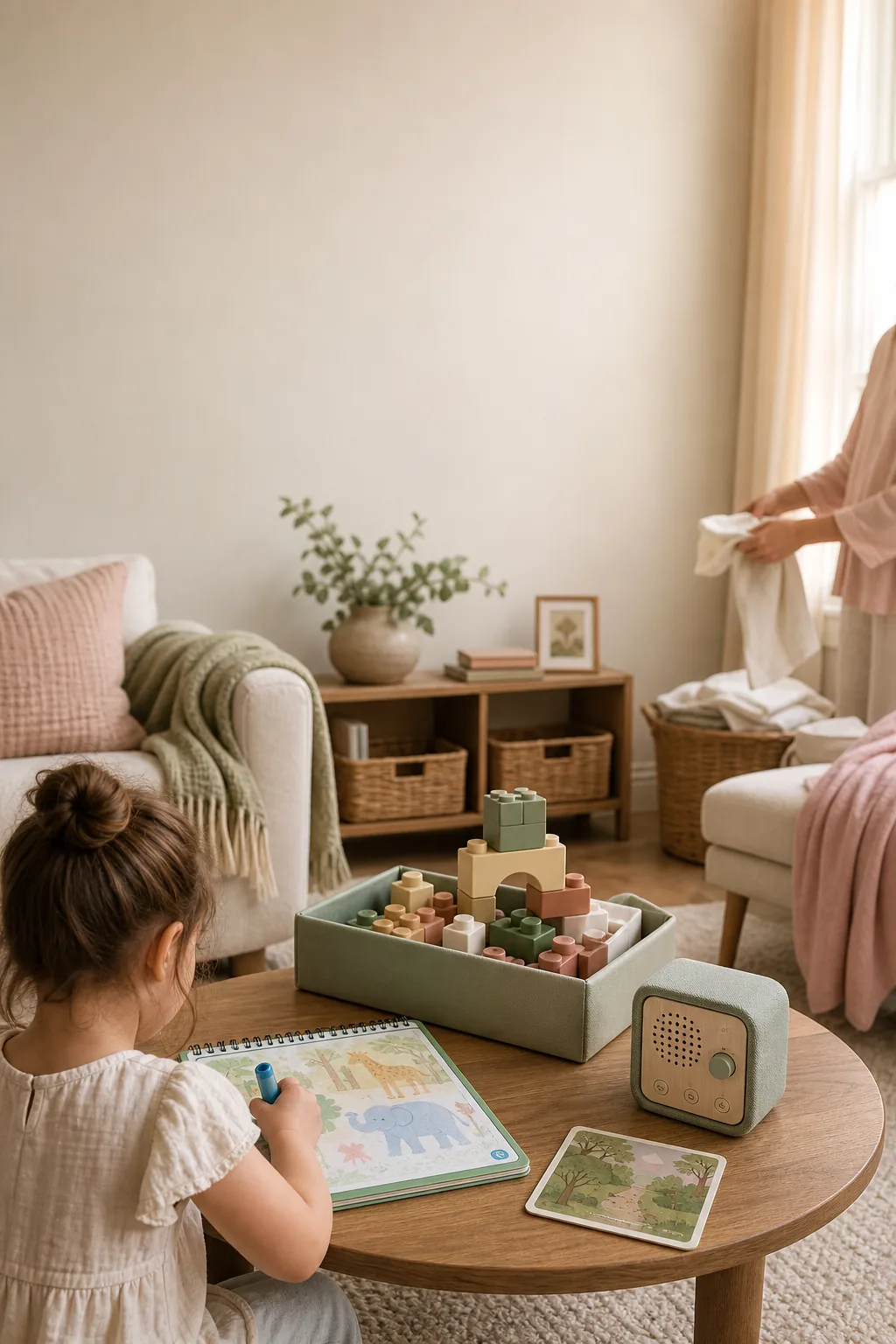
“Quiet time” can sound like a promise that a toddler will happily play alone while an adult finishes a list. That is not a fair standard for the child—or for the product. A more useful goal is a predictable lower-energy interval with a clear boundary, one familiar activity, and an adult available at the distance the child and space require.
Before buying anything, test the three activity types with what you already own: paper and a chunky crayon for coloring, a handful of large blocks for building, or an adult-read library book or familiar audio story for listening. Notice which action your child returns to without needing a new prompt every minute. That behavior is better buying evidence than a “must-have toddler toy” list.
Safety comes before independence
Quiet time is not unsupervised childcare. Follow every package age label and warning, inspect parts for damage, secure furniture and cords, remove choking hazards, and stay as close as your child and setting require. The selected products span different manufacturer age ranges; the youngest printed age does not automatically make an activity appropriate for your child or room.
The 30-second play-style table
| If your child tends to... | Try this path | Current product anchor | Main adult setup | Main trade-off |
|---|---|---|---|---|
| Repeat a simple mark-and-reveal action at a table | Color | Melissa & Doug Water Wow! Safari | Fill the water pen, model one page, protect the surface from drips, and store the pen after. | Only four boards; it needs drying time and water still makes small wet spots. |
| Stack, rebuild, sort, or make small pretend scenes on the floor | Build | LEGO DUPLO Classic Brick Box 10913 | Offer a limited subset in a contained area instead of dumping all 65 pieces. | More pieces mean more cleanup, and open-ended play may be energizing rather than quiet for some children. |
| Settle through a familiar story, song, or sound while hands rest or draw | Listen | Yoto Mini (2024 Edition) | Complete adult setup, preload or choose the content, set volume, and keep cards organized. | Higher entry cost, separate content purchases, charging, app/Wi-Fi setup, and a small-parts warning. |
Compare three current quiet-time paths
1. Color: Water Wow! Safari
Best fit: A preschooler age three or older who likes short, repeatable table activities and can use the water pen according to the package directions.
Melissa & Doug currently describes the Safari pad as four reusable water-reveal boards with search-and-find prompts and a chunky refillable pen that stores in the spiral cover. The pages reveal color when wet and turn white after drying. The official age range is 3–6.
- Low-prep advantage: no paint, ink, batteries, or app.
- Adult job: fill and close the pen, model gentle use, manage drips, and let the pages dry.
- Skip it if: your child chews art tools, dislikes seated mark-making, or is outside the current age guidance.
This article contains paid links. We may earn a commission if you buy through them, at no extra cost to you.
2. Build: LEGO DUPLO Brick Box 10913
Best fit: A child who repeatedly stacks and rebuilds large pieces and has a contained floor or table zone with age-appropriate adult supervision.
LEGO currently lists set 10913 for ages 18 months and older. The storage box includes 65 pieces, two DUPLO figures, number bricks, a car, and other familiar elements intended for sorting, stacking, and pretend play. No batteries are required.
- Open-ended advantage: the same subset can become different simple builds.
- Adult job: inspect pieces, select a manageable handful, contain the play zone, and count pieces back into storage.
- Skip it if: loose-piece cleanup creates more stress or building reliably turns into high-energy throwing or dumping.
3. Listen: Yoto Mini (2024 Edition)
Best fit: A child age three or older who already settles with familiar audio and a family willing to manage device setup, charging, volume, and the content-card system.
Yoto describes the Mini as a compact screen-free audio player with a pixel display, up to 14 hours of battery play per charge, USB-C charging, 3.5mm and Bluetooth headphone support, white noise and sleep sounds, and app-based setup. It has no microphone, camera, or ads.
- Low-piece advantage: one selected card can define the activity.
- Adult job: configure the player and app, choose age-appropriate audio, set safe volume, charge it, and keep cards accounted for.
- Pause: Yoto displays a choking-hazard warning for small parts and says it is not suitable for children under 36 months.
- Skip it if: a lower-cost library audiobook or speaker already solves listening time, or another device and content ecosystem would add friction.
Use the five-minute setup test
- Choose one path: color, build, or listen—not all three at once.
- Reduce the choices: one pad, a small block subset, or one preselected story is enough.
- Prepare beside the child: fill the pen, make one tiny build, or start the audio together.
- Name your distance: say where you will be and remain as close as safe supervision requires.
- Use a short visible interval: choose a timer your child already understands. Do not promise that a product will hold attention for a particular duration.
- End when promised: return, acknowledge the transition, and reset the materials together.
A simpler script than “go play”
“It is quiet time. You can choose the water book or six big blocks. I will fold laundry right here. When the timer ends, we will put it away together.”
The script gives the child an action, a boundary, the adult's location, and a clear ending. If the child cannot manage the separation that day, shorten the interval or use together-but-separate play: sit nearby with your own task while the child uses the activity. That is still practice. It is not a failure and does not require another purchase.
What to skip in a quiet-time basket
- Anything outside the child's current age label or abilities.
- Damaged toys, loose magnets, button batteries, cords, water beads, balloons, or pieces that create a choking or entanglement risk.
- An activity that requires constant adult repair, opening, or instruction.
- A giant selection that invites dumping before choosing.
- A product marketed with guaranteed “hours of independent play.” Attention varies, and quiet time is a practiced routine rather than a product outcome.
Our honest decision
Start with Water Wow when the child already enjoys contained table art and the adult wants the smallest setup. Start with DUPLO when the child naturally rebuilds and a limited-piece play zone is realistic. Consider Yoto Mini when listening already settles the child and the family values a dedicated audio system enough to accept the higher cost and setup.
Start with none of them if household art supplies, existing large blocks, or a library audiobook already reveal the child's best path. The best quiet-time product is not the one that promises the longest break; it is the one that fits the child, the supervision plan, and the cleanup adults can repeat.
Research notes
This guide was rebuilt on July 19, 2026 from current first-party manufacturer information and current product destinations. Tired Mom Finds has not personally tested the selected products. Manufacturer pages establish current listed features, age guidance, and warnings—not how long a child will play or whether an item is right for a particular family.
FAQ
What is a realistic quiet-time activity for a three-year-old?
Start with one familiar, age-labeled activity in a child-safe area while an adult remains available. A reusable water-reveal pad, a small set of chunky building pieces, or a preselected audio story can each fit a different play style.
How long should quiet time last?
There is no universal target. Begin with a short interval your child can understand, end when you said you would, and build only if the routine remains comfortable. A product cannot guarantee a particular number of minutes.
Does quiet time mean a toddler can be left unsupervised?
No. Quiet time is a lower-energy routine, not a substitute for age-appropriate supervision. Follow the product's age label and warnings, prepare a child-safe space, inspect pieces, and stay as close as your child and setting require.
Choose one path—not a whole new playroom
Save this guide, then notice whether your child returns to coloring, building, or listening.
Tired Mom Finds
Get practical, realistic routines for busy days
Weekly no-fluff tips for calmer mornings, simpler evenings, and less mental load.